 Print
Print
7-21-2003
by Trevor Hofmann
A Distinctly American Luxury Car
Lincoln's Continental concept was introduced at the Los Angeles Auto Show over a year ago, a follow up to a 1960s inspired design theme that showed up at the New York show as the MK 9 two years prior.
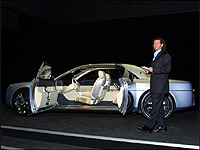 |
| Lincoln Design Director Gerry McGovern unveiled Lincoln's new Continental Concept vehicle at the 2002 Los Angeles Auto Show. (Photo: Ford Motor Company) |
After nearly two years of research and development Lincoln Mercury President Brian Kelley and Design Director Gerry McGovern showed it to the world. The response from the motoring press was favorable for the most part, with a few dissenters quibbling about its retro styling looking backward when the brand should be spending more time looking forward.
 |
| The early '60s Continental was a groundbreaking vehicle, larger than life yet somehow as gracefully styled as any American car of its era. (Photo: Ford Motor Company) |
I happen to disagree with the nay Sayers, believing sometimes when things aren't going as well as they could be it's necessary to regroup, and then ponder both successes and mistakes from the past before pressing forward. Lincoln, much in need of refocusing its car business, looks to be doing likewise.
And what a fabulous history the brand has to pull from. The early '60s Continental was a groundbreaking vehicle, larger than life yet somehow as gracefully styled as any American car of its era. Of course, design is subjective and your opinion may differ. Maybe you think the Buick Riviera of the same time period was the American icon car, or perhaps the 1963 Chevy Corvette split window coupe. And how can I forget the venerable Mustang? Still, the Continental was special.
And the first major auto show of 2002 needed a special concept to bring attention to the Lincoln brand, as the coming year would be especially important according to Kelley.
"This is a pivotal year in Lincoln's long-term growth strategy," Kelley stated. "We are launching three new products this summer to build on our strong foundation, and we are presenting the Continental to show where we will take the brand in the near future."
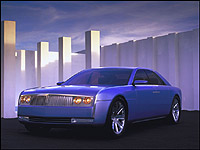 |
| the first major auto show of 2002 needed something special to bring attention to the Lincoln brand, and the Continental Concept did just that. (Photo: Ford Motor Company) |
The three new products were the redesigned 2003 Town Car, the basis for nearly the entire limousine trade, the completely revamped Navigator and all-new Ford Explorer based Aviator.
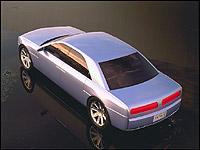 |
| The Continental's lines are sharp, clean and generally minimalist compared to the soft and curvy creations of recent years. (Photo: Ford Motor Company) |
While the first two have been extremely successful in their respective markets, the Aviator has languished in the ultra-competitive midsize SUV segment to the point where Ford Motor recently announced its almost certain demise, joining the brand's Blackwood pickup truck embarrassment even before the sport utility's first year of sales is completed.
More reasons that a Lincoln success story is paramount. Something similar to the Continental concept, put into production, could be that saving grace. Its lines are sharp, clean and generally minimalist compared to the soft and curvy creations of recent years.
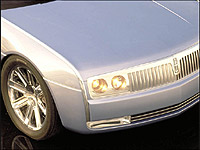
While it could be said the concept's grille is almost too understated, it's a beautifully executed display of aluminum brightwork that spans the car's entire width, encapsulating two remote light generator headlamps at each side. Incidentally these headlights use fiber optic cables to transmit light from a single source reducing required energy while emitting two and half times the beam strength of regular halogen bulbs, the result of Ford's relationship with Philips Lighting.
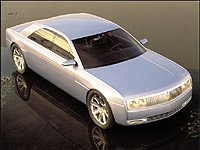 |
| The concept's beautifully executed grille is almost too understated. (Photo: Ford Motor Company) |
A noticeable lack of wraparound lighting clusters front and rear is distinctive, although possibly not as safe when viewed from the side at night. That profile view is particularly attractive though, and would be marred if altered for safety's sake. Like the early '60s Continental a thin strip of chrome trim highlights the car's broad shoulder lines from front to back, starting from grille level, straddling suicide-style rear doors and ending by wrapping downward toward the tailpipes in the rear.
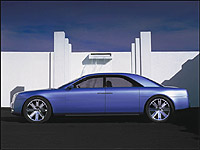 |
| As dramatic and stylish as the Continental concept is, it still retains the look of a classic Lincoln. (Photo: Ford Motor Company) |
Its rear styling might be its most cohesive aspect, combining a sweeping C-pillar into a large rear decklid that gently drops rearward integrating unique dual, horizontal taillights bisected by Lincoln's legendary badge.
I think what is most important about the Continental design exercise is that it looks like a Lincoln. It pulls from the brand's healthy gene pool leaving the uninspired BMW (LS) and Jaguar (Town Car) influences in the past, where they should stay.
"Continental embodies the qualities that define the design direction Lincoln has chosen: elegance, simplicity, precision and an overall restraint," stated Lincoln Design Director Gerry McGovern who unveiled the new concept in Los Angeles. "Someday, a flagship like Continental could join Lincoln's showroom," he added. "But the emphasis on package efficiency, the approach to surface development and detailing, and certain Continental design cues absolutely will see production."
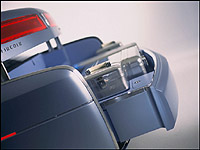 |
| Rather than the regular forward tilting, front hinged trunklid, the Continental concept incorporates a hydraulically powered decklid that remains completely horizontal in all positions. (Photo: Ford Motor Company) |
But while pulling cues from yesteryear Lincoln hasn't forgotten that new age buyers expect evolutionary technologies. The concept's trunk, however, is more revolutionary than evolutionary, boasting a most unorthodox but highly functional cargo system. Rather than the regular forward tilting, front hinged trunklid, the Continental concept incorporates a hydraulically powered decklid that follows a parallelogram as it opens remaining completely horizontal in the process. Lincoln says this keeps the tail lamps fully visible even when the trunklid is raised, enhancing safety, while providing superior access over traditional trunks.
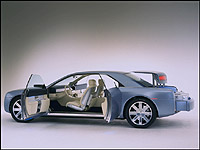 |
| "The vehicle must be engaging for the driver, supremely comfortable for everyone, and the car should do the work for you." (Photo: Ford Motor Company) |
Adding to its convenience are three sliding storage drawers that make up to 580 L (20.5 cu ft) of stowage, plus a large cargo tray that remotely slides out of the trunk presenting a set of Zero Halliburton luggage and golf club cases - very nice.
"In an executive car, there are inviolable principles," McGovern commented. "The vehicle must be engaging for the driver, supremely comfortable for everyone, and the car should do the work for you. Above all, space must be used efficiently and ingress and egress must never be compromised."
On that last note Lincoln has come with a few innovative solutions that probably will never make production, but nevertheless make for flashy concepts. The driver and passenger doors are powered, and remotely actuated either by touching the flush mounted aluminum door handles or the car's key fob.
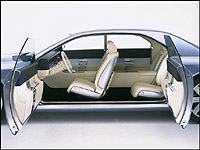 |
| With hinges that open 90 degrees, the concept's doors make for easy entry and exit. (Photo: Ford Motor Company) |
Compared to rear-hinged pickup truck doors, the Continental's clamshells open separately (without having to open the front doors first), expanding to nearly six feet from door jam to door jam. The concept uses articulating hinges that open to 90 degrees, attached to dual structurally rigid ring frames encompassing the A-pillars, C-pillars, lower sills and roof rails, negating the need for B-pillars.
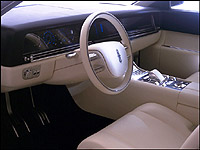 |
| The Lincoln Continental concept's dominant horizontal exterior lines continue within the interior. (Photo: Ford Motor Company) |
Its full-width dash is structural too, but most will just appreciate its simplistic beauty. The most dominant lines, like as on the rest of the car, are horizontal, giving it the appearance of even greater width and length. High grade plastics and attractive brushed aluminum trim combine with sumptuous leather to give the Continental an extremely inviting cabin.
Each door panel and the headliner features translucent silk shaded indirect fiber optic lighting, shedding a soft light on the Eames lounge chair-inspired seats. Both these and the headliner itself are covered in cream-colored full-grain aniline leather, the same tone of leather that surfaces the instrument panel and doors, accented with Midnight Blue leather. What's more, the Continental concept might be the only car that begs driver and passenger to remove their shoes, as its floor features a midnight blue hue of close-sheared sheepskin.
While cozy, Lincoln made sure that interior space wouldn't leave occupants cramped. The front seats are multiply adjustable, but those in the rear will make passengers feel as if they've been given an upgrade from coach to business class. While adjustable forward and rearward by up to 200 mm (8.0 in), they can be reclined into a bed if the front seat back is folded flat.
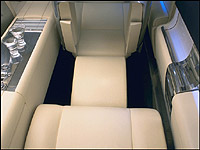 |
| The Lincoln's interior won't leave occupants cramped, offering copious amounts of legroom. (Photo: Ford Motor Company) |
Other premium features include integrated laptop tables in the console, which are cool but don't take into consideration the fact that cars have a much longer shelf life than computer gear (but I want them anyway).
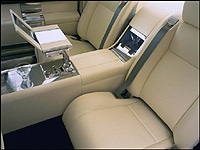 |
| The top-tier Lincoln concept integrates laptop tables for business and a compartment that houses crystal glasses and a drink dispenser for pleasure. (Photo: Ford Motor Company) |
There's also a briefcase holder built into the back of the front seats, complete with a custom fitting Zero Halliburton attaché. It is designed so that it doesn't need to be removed from its place to open it up if the front seatback is folded down.
Vying for Maybach 62 customers the Continental houses crystal glasses and a drink dispenser between the rear seats. Also, like the new Rolls-Royce Phantom each door includes a rear umbrella holder, plus compartments for odds and ends such as the customized humidor already in place. Being that the Continental appeared almost a year prior to both the Maybach and Rolls-Royce, it's not clear if they were inspired by the Lincoln to include such appointments or if their conspicuous arrival just happened by chance. I'm sure Ford Motor would like to think the latter.
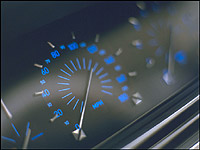
The Continental also features reconfigurable displays in its instrument panel, with the ability to view engine functions, telematics, and vehicle systems, or get directions from the navigation unit or music via the THX-certified audio system.
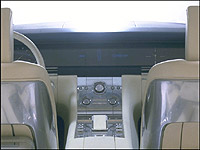 |
| The Continental concept features reconfigurable displays in its instrument panel, which also houses a navigation system and concierge service. (Photo: Ford Motor Company) |
A concierge service is also included, perfect for checking the weather, reserving a favorite table at a restaurant, requesting route assistance or for that checking into personal market reports. The display itself uses an Organic Light Emitting Diode technology (OLED) for reportedly "sharp, defined images", developed for the Continental concept by Pioneer Electronics.
 |
| A big 414-hp 6-liter V12 engine powers the extravagant Continental concept. (Photo: Ford Motor Company) |
An interior fit for royalty deserves a team of Lipizzaners up front; therefore Lincoln has included the Continental with the modern day equivalent. Nothing less than six liters of V12 muscle powers the rear wheels, producing 414-hp available at 6,000 rpm and an equally robust 413 lb-ft of torque maximized at 5,270 rpm. A six-speed automatic transmission no doubt gets pulled from the Jaguar parts bin, a handy resource Lincoln previously made use of in engineering its LS.
Larger than life 22-inch polished aluminum wheels riding on Continental tires, P275/45R22 in the front and P295/40R22 in the rear, deliver an amply large contact patch to assist the sophisticated multi-link 4-wheel independent suspension do its job. It includes driver-selectable electronic damping for personalized optimization of ride and handling, the latter benefiting from a variable assist, speed-sensitive 4-wheel steering system.
Four-wheel is the theme when discussing brakes as well, with ventilated discs all-round - 405 mm (16.0 in) up front and 395 mm (15.5 in) at the back - plus 6 and 4-piston calipers at the front and rear respectively. Anti-lock is obviously included, as is an electronically actuated parking brake - probably borrowed from sibling marque Jaguar as well.
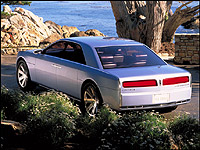 |
| In one word, the Continental is 'big'. It's 5,444 mm (214 in) long, 1,950 mm (76.7 in) wide, and has a wheelbase spanning 3,470 mm (136.6 in). (Photo: Ford Motor Company) |
And those brakes had better be good, as the Continental is no midsize Ford Taurus based Lincoln as its production predecessor was. Instead it's large, reaching 5,444 mm (214 in) in length, 1,950 mm (76.7 in) in width, and 1,500 mm (59 in) in height. Its wheelbase spans 3,470 mm (136.6 in) directly contributing to its limousine-like legroom, itself stretching to 981 mm (38.6 in). Without venturing into all the interior dimensions suffice it to say it is mighty accommodating.
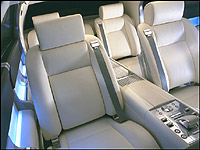 |
| If the Continental concept is ever built it will easily replace Lincoln's Town Car as the favorite among limousine builders. (Photo: Ford Motor Company) |
The gorgeous sheetmetal is anything but. Rather a composite outer skin covers an aluminum and composite body-on-frame chassis - an ultra-high-tech approach to a rather outdated construction method. That body-on-frame method, however, results in a particularly rigid platform for stretching the wheelbase, which would allow the Continental, if produced, to replace Lincoln's Town Car as the favorite among limousine builders. And on that thought I have just one suggestion if it does get built. Please, Lincoln, hire a chiropractic seat specialist to engineer the rear seat. I get picked up in limousines from airports routinely, and find the Town Car to have one of the least comfortable rear benches this side of a 2004 Pontiac Grand Prix - a regular complaint from limousine riders according to various chauffeurs.
But of course, the Continental concept's rear seats look anything but uncomfortable. Actually, it might offer the most inviting rear accommodations I've ever seen - and that from someone who has spent a fair bit of time stretched out in the back seat of a Maybach 62.
 |
| With a long missed, distinctly American design flavor, the Continental concept would be a welcomed addition to Lincoln's lineup. (Photo: Ford Motor Company) |
But of course, in the end, all will be merely the stuff of dreams unless Ford Motor gets the resources to improve Lincoln's car line. Maybe the fall of Blackwood and Aviator will do the brand some good, and help it refocus on the body type that got them to where they are in the first place, the sedan. The Continental concept, or something closely resembling it, would be a fine successor to Lincoln's Town Car, offering a great improvement in dynamic performance while simultaneously restoring a distinctly American design flavor, long missed. We can only hope.
Specifications: