Gas prices are rising and falling... and rising again and falling again. Small
fuel-efficient cars, or econoboxes, offer a golden opportunity to become immune to this yo-yo. Since 2004, the Toyota Yaris has been dominating the market, easily overtaking such rivals as the Hyundai Accent and
Nissan Versa.
 |
| People buy the Toyota Yaris not just for the sake of buying a cheap car, but because they love it! This econobox now enjoys cult-like popularity. |
Back in 2001, there were only four models in this segment. In recent years, however, there's been an explosion with regard to the number of alternatives and the overall sales figures. The end is nowhere near; in fact, other models will soon join the party, like the new
Ford Fiesta.
With that in mind, I was handed the keys to a 2009 Toyota Yaris Hatchback LE, which is the base model in 5-door configuration. The higher-end RS essentially stands out with a couple of added features and, of course, a $4,500 premium.
The Yaris lineup also includes a 4-door sedan which appeals to more conservative customers. The car is 48-centimeter longer overall, yet the interior lacks the versatility of the hatchback. Besides, it does not sport the same facial expression as the latter.
More versatileTruth be told, it's easy to fall in love with the 5-door Yaris. The cutesy look and practical ways make it more attractive than a plain-looking sedan with a narrow trunk opening.
In the hatchback, the 60/40 split rear seats fold in a flash to accommodate large items, like a plasma TV. Don't even think about it if you're using the sedan!
As a matter of fact, folding the seatbacks triples the available cargo room (from 228 to 728 liters). Granted, the maximum capacity of a Honda Fit is more than double (1,622 L) and the new Chevrolet Aveo5 can hold up to 1,190 liters, but if you have to choose between the Yaris Hatchback and Sedan (with a trunk of only 365 liters), the decision is pretty easy.
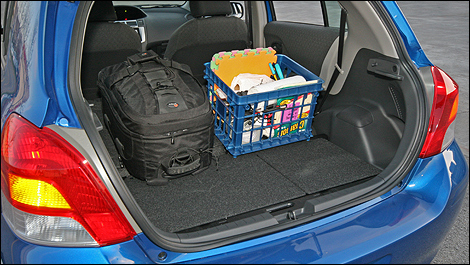 |
| The versatile trunk of the Yaris Hatchback is easily accessible and, while the cargo capacity might not be the largest in the segment, it's still pretty decent. |
And while 228 liters might not seem like much when all the seats are occupied, let me tell you that I was able to fit no less than five large grocery bags under the cargo cover.
 |
| The unusual layout of the dashboard, with the instrument cluster in the upper middle section, proves to be distractive at first but you quickly get used to it. |
The interior of the Yaris Hatchback also contains a slew of convenient storage compartments -- big and small. Actually, there are six bins around the front seats and three glove boxes integrated to the dashboard.
Fun to driveDriving a Yaris requires some getting used to, especially on your first night out. After starting the engine and turning the headlights on, you might think for one second that somebody just stole the instrument cluster; there's nothing behind the steering wheel!
The thing is, Toyota decided to put the various gauges and instruments (speedometer, tachometer, fuel gauge, trip meter, etc.) under a small dome right in the upper middle section of the dashboard. I quickly got used to this unusual layout. Besides, it allows the driver to keep his or her eyes on the road more often.
Some people believe that all econoboxes are synonymous with a stiff ride. I'm happy to report that the suspension of the Yaris, while firm, boasts decent travel and seldom overreacts to road imperfections. The steering is light and precise, which makes for good maneuverability, as evidenced by the short turning diameter (9.4 meters vs 10.4 for the sedan).
What's more, the compact size and expansive windows ensure excellent visibility. Parking maneuvers pose no problem whatsoever. An intermittent setting for the rear window wiper would have been appreciated, though, particularly in misty conditions.
A zippy engine!The Yaris also benefits from a competent powertrain. Despite producing barely 100 horsepower, this 1.5 liter mill delivers linear accelerations and adequate passing power for the city.
Of course, 12 seconds to go from 0 to 100 km/h won't excite anyone, especially not video game enthusiasts. The Yaris competes in a totally different championship, the goal of which is to limit as much as possible the number of visits to the gas station.
 |
| The small 1.5 liter mill delivers linear accelerations and adequate passing power for the city. Plus, it's great on gas. |
With an average fuel economy of 7.5 liters per 100 kilometers (achieved through moderate use of the throttle), the 42-liter tank allows a range of over 500 kilometers, maybe more with smooth accelerations and calculated braking maneuvers. Now that's a game I like to play -- and it pays!
The 4-speed automatic transmission of my tester helped make the driving experience smoother by making shifts virtually seamless. This option will cost you $1,000, but it will make your life easier and more enjoyable in rush-hour traffic. Obviously, Gran Turismo fans will prefer the standard 5-speed manual.
Should you trust TomTom?For 2009, Toyota offers a TomTom navigation system with the Yaris. It features a 9-cm display, which is not very big, but it does add a premium touch to this small entry-level car.
 |
| The 2009 Yaris Hatchback can be equipped with a TomTom navigation device which adds a premium touch to this small entry-level car. However, the system has troubles with accuracy and it certainly isn't cheap! |
However, at over $1,650 (prices vary from one dealership to another), this GPS device isn't cheap. Furthermore, during my road test, TomTom had troubles with accuracy at times. Funny mistake: the system failed to recognize the civic number (420) of our very own headquarters in Laval. It gave me another number (419) that does not even exist! Go figure...
On the other hand, the fact that TomTom is removable makes it less likely to be stolen... provided that you safely store it away when you leave the car!
Appropriately pricedThe 2009 Toyota Yaris Hatchback starts at $14,360. My LE tester featured the automatic transmission ($1,000) and the Convenience Package ($2,205), which includes ABS brakes with Electronic Brake force Distribution (EBD), air conditioning, the aforementioned split-folding rear seats (coming standard is a one-piece seatback, which is a lot less handy), power windows, cruise control and keyless entry. Adding TomTom and including taxes pushed the bill above $20K.
Let's face it: that's the price you have to pay these days to own a brand-new econobox!
 Print
Print