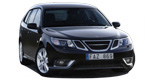
Naturally, the Aero is the preferred ride for sportier drivers, with its turbocharged V6 engine delivering 255 horsepower (up 5 from last year's model) and a not insignificant 280 lb-ft of torque. The manufacturer's estimates for acceleration from 0-100 km/h (5.7 seconds) place the Aero in some lofty company.
The 6-speed manual was the preferred choice, apart from the shift lever being set too far back for my liking (as was the base model's 5-speed) and the clutch being a tad light.
The 6-speed automatic would have scored higher if it had come with paddle shifters, as is now the standard in this segment. Instead, the Saab features buttons just above the face of the steering wheel; functional, but not very fun.
The automatic transmission, when placed in Sport mode and left in the fully automatic setting, actually worked extremely well, holding lower gears longer under acceleration and shifting with decent speed.
Impressive Handling and RefinementNot only does the Saab Aero deliver increased engine performance, it also offers a slightly stiffer suspension set-up. All versions are equipped with a fully independent suspension system featuring MacPherson struts up front and a multi-link design in the back.
While the base model had too much rebound for my liking, the Aero performed admirably along the undulating pavement and through the quick corners. Past Saabs have been criticized for being "too mushy" and, while the new 9-3 Aero does not match a German competitor for tautness, it does offer the best compromise between ride comfort and roadholding ever in a Saab.
The car also benefits from a passive rear-wheel steering system called ReAxs. This design reduces the understeer that is common to front-wheel drive cars and helps the car rotate around corners with precision and ease.
Of course, being a front-wheel drive car with decent power, the question of torque steer will always raise its ugly head.
In the past, Saab has suffered as much as any manufacturer when attempting to extract maximum performance from a front-wheel drive layout. The second generation 9-3 line included the high-output Viggen model; although it produced only 225 horsepower, it was, by and large, undriveable. The lessons of the past have been learned, though.






 Print
Print