Undoubtedly the Best Explorer Yet With its new exterior styling, upscale interior and increased under-hood caffeine, the
2006 Explorer is by far the best iteration
 |
| There's many more improvements under the skin than the 2006 Explorer's subtle styling upgrade makes known. (Photo: Rob Rothwell, Canadian Auto Press) |
of this venerable mid-size SUV to date. Since its introduction in 1991, this best-selling SUV has undergone a series of refits giving rise to today's polished performer. A few of the more notable revisions brought forth an independent rear suspension system, optional V8 power and Ford's AdvanceTrac electronic stability system with rollover prevention. Along the way the Explorer also grew in size and matured in refinement, comfort and performance.
Having recently attended the launch of the all-new
2007 Explorer Sport Trac, I held high expectations for this week's tester, which is the root vehicle on which the Sport Trac was developed. However, the Explorer is shorter than the Sport Trac. In fact, readers may be surprised to learn that at 4,912 mm (193.4 in)
 |
| The Explorer appears larger than it actually is. (Photo: Rob Rothwell, Canadian Auto Press) |
the third-row-equipped Explorer is almost identical in overall length to the Audi A6 and Nissan Maxima sedans. So while it may look big and imposing, accommodating up to seven occupants, the Explorer casts a relatively small shadow, enabling easy maneuvering in tight spaces. Whether navigating congested parking lots or crawling up goat trails, the Explorer's rack-and-pinion steering combined with a very tight turning diameter of 11.2 m (36.8 ft) make it a very nimble SUV indeed. These qualities are as beneficial to the parking lot warrior as they are to the off-roader, as is when speaking of the latter, Ford's ControlTrac full-time four-wheel-drive (FWD) technology, which includes electronically activated low-range gearing to overcome the most challenging vertical variations.
I had the opportunity to put Ford's ControlTrac to the test during the launch of the Explorer Sport Trac and came away very impressed. The system uses sensors to monitor and a
 |
| On- or off-road the Explorer's suspension setup and sophisticated
electronic driving aids make for a stable, confidence inspiring ride. The Explorer appears larger than it actually is. (Photo: Rob Rothwell, Canadian Auto Press) |
nticipate wheel slippage, seamlessly redirecting torque to the front or rear wheels before traction is lost. With 208 mm (8.2 in) of ground clearance, the Explorer doesn't stand as high above the terra firma as some of its competitors, however, skid plates are available to protect the vitals should the need arise. The moderate rate of ground clearance leads to easier ingress/egress exercises while improving the vehicle's resistance to rollover by reducing its centre of gravity. When combined with the Explorer's 4-wheel independent suspension setup, front and rear stabilizer bars and a much stiffer frame than last year, the net effect is remarkably good handling and tenacious high-speed grip - all relative to an SUV of course. Predominantly responsible for the improved handling - and I
 |
| The refined chassis can be felt inside. (Photo: Rob Rothwell, Canadian Auto Press) |
might add thoroughly improved ride - is a 63 percent increase in bending stiffness and a 55 percent increase in twisting (torsional) stiffness in the vehicle's frame.
The added structural rigidity enables the Explorer's suspension to soak up potholes and the like without transferring shock waves into the vehicle's body - and by extension you and I. Most pleasing in the arrangement is the absence of rattles, thumps and garden variety undercarriage noises often associated with 4WD vehicles. And I must say, for me, the absence such irritants is an important aspect of a vehicle's overall solidity and operational integrity. The Explorer's unruffled suspension is suitably forgiving while producing a well-controlled ride over the roughest of surfaces, yet its calibration feels a touch on the firm side in contrast to some competitors; the trade-off being better off-road handling dynamics. On road or off, drivers will notice more power hitting each of the Explorer's wheels thanks to an upgraded V6 mill and a new V8 drivetrain for 2006.
The improved, 210 horsepower V6 engine displaces 4.0 litres (245 cu in) and is mated to a 5-speed autobox to form the Explorer's
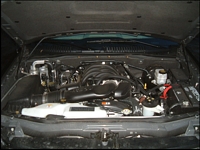 |
| The V8-six-speed combo is one refined drivetrain. (Photo: Rob Rothwell, Canadian Auto Press) |
base drivetrain. I had the good fortune of testing a V8-powered Explorer, which for 2006 gains a whopping 53 horsepower for a total output of 292 ponies and 300 foot-pounds of torque. That's enough to motivate the Explorer with impressive results; look for 0-96 kph (0-60 mph) times of 8.17 seconds. The healthy dose of V8 power also ups the Explorer's maximum tow rating to 3,311 kg (7,300 lbs). Albeit there is plenty of juice produced by the 3-valve per cylinder, 4.6 litre (281 cu in) mill, more deserving of accolades is the outstanding operational refinement of this unit and the 6-speed automatic transmission to which it is affixed.
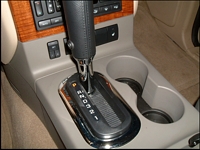 |
| The six-speed automatic improves performance, makes for smoother shifts and decreases fuel consumption - the best of all worlds. (Photo: Rob Rothwell, Canadian Auto Press) |
The honey-smooth, hushed performance of this sophisticated duo rivals luxury-car expectations - it's just that good.
Both the V6 and V8 engines for 2006 spew fewer emissions into the atmosphere than last year's versions; Ford also claims a 10 percent increase in fuel economy for the new V8 over last year's edition. Even so, the V8-powered Explorer is a thirsty devil. According to my tester's computer information centre, I was averaging 17.2 litres per 100 kilometres of driving. In fairness though, my driving pattern wasn't geared toward economy; more highway excursions and a lighter right foot would have improved the results. Thanks to the Explorer's tremendous level of occupant comfort, in at least the first
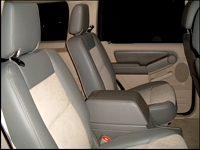 |
| The new Explorer is very quiet on the highway, with little road and wind noise evident. (Photo: Rob Rothwell, Canadian Auto Press) |
two rows of seats, the extra highway miles would have been delightful indeed.
On this note the new Explorer is very quiet on the highway, with little road and wind noise evident. That's quite an accomplishment given the significant noise levels that aggressive tire treads and a boxy shape can generate at highway speeds. Much of the Explorer's relaxing nature can be found in its many amenities and aesthetically attractive environs. Ford has transferred a plentitude of the un-truck-like elegance from the cab of its F150 line of pickups into the Explorer, resulting in a sensibly laid out, well-constructed cabin featuring
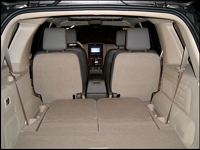 |
| The power actuated rear seat opens up a sizeable cargo area. (Photo: Rob Rothwell, Canadian Auto Press) |
many soft-touch materials and chrome detailing. Particularly noteworthy for its convenience is an optional power-actuated third row seat. This split bench can be folded flat into the floor or lifted into place by the push of a button - no need to lean into the vehicle dithering with straps and levers while dirtying freshly minted pants on a soiled rear bumper. My fully loaded Limited tester also aided driving chores via a navigation system and steering-wheel-mounted audio, cruise and HVAC controls. A roof-mounted DVD entertainment system with wireless headphones kept the younger set entertained and entranced, which, as every parent knows, can be divine on a long journey.
Every parent also knows that occupant protection is of paramount importance. Ford has installed the latest in airbag
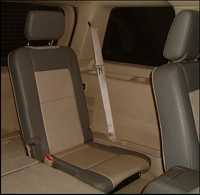 |
| The third row seats tight for adults, but nicely finished. (Photo: Rob Rothwell, Canadian Auto Press) |
technology into the Explorer, starting with driver and front passenger adaptive-venting airbags. A five-level front-passenger sensing system works in conjunction with adaptive airbag tethering to ensure airbag deployment matches occupant needs. Standard safety equipment also includes front seat, side-mounted airbags; optional is an airbag canopy system providing head protection to first and second row occupants. Along with optional cranial protection, Ford offers a number of standalone options and option packages enabling purchasers to tailor the Explorer to their particular needs and desires. But even in base form, which for 2006 is the XLT, the Explorer is a very well equipped vehicle. Graduating to the Eddie Bauer edition adds more
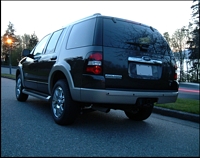 |
| You should consider the new Explorer if looking for a new SUV. (Photo: Rob Rothwell, Canadian Auto Press) |
power features and creature comforts before topping-out with the fully loaded, limousine-like Explorer Limited.
With a vast array of domestically and foreign manufactured mid-size SUVs to choose from, prospective buyers have plenty of homework to do in researching and selecting the vehicle most suited to their needs, tastes and pocketbooks. I strongly urge those hitting the books to closely study the 2006 Explorer. I came away from this week's tester very enlightened and delighted. The V8-powered 2006 Explorer is far more polished a performer than I had anticipated, based on previous Explorer encounters. This is undoubtedly the best Explorer yet.
Specifications (Limited V8): - Price Range (Limited MSRP): $51,299 - $56,609
- Body Type: 5-door SUV
- Layout: front engine, 4WD
- Engine: 292-hp, 300 lb-ft of torque, 4.6L (281 cu in), SOHC, 24-valve V8
- Transmission: 6-speed auto
- Brakes (front/rear): disc/disc, ABS, EBD, BA
- Curb Weight: 2,135 kg (4,706 lbs)
- Seating Capacity: max. 7 (2 / 3 / 2)
- Payload: 690 kg (1,520 lbs)
- Towing Capacity (estimated): 3,311 kg (7,300 lbs)
- Fuel Economy (city/hwy): 16.8 / 11.7 L/100 km
- Warranty (mo/km): 36/60,000 comprehensive - 60/100,000 powertrain
- Direct Competitors: Chevrolet TrailBlazer, Dodge Durango, GMC Envoy, Isuzu Ascender, Jeep Grand Cherokee, Mercury Mountaineer, Mitsubishi Endeavor, Toyota 4Runner
- Web Site: www.ford.ca
 Imprimer