In Hot Pursuit of Import Customers
What's a
Pursuit? Well, if you're from the U.S.A. it probably won't mean much of anything unless you've been surfing the
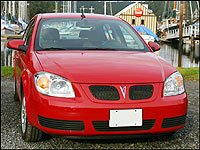 |
| The new Pontiac Pursuit will be replacing the aging Sunfire in GM Canada's sportiest entry-level division. (Photo: Trevor Hofmann, Canadian Auto Press) |
message boards filled with frustrated consumers wishing they had the opportunity to buy Pontiac's latest compact sedan.
The Pursuit, which effectively replaces the aging Sunfire in GM Canada's sportiest entry-level division, is integral to success north of the 49th where small cars regularly account for more than 50 percent of new vehicle sales - except for Quebec where compact dominance reaches 65 to 70 percent. Such is not the case south of the border, therefore no Pursuit. Pontiac's highly touted new
G6 will be the U.S. division's entry car, despite its midsize dimensions.
But why should Americans care if they can't get it? Isn't the new compact merely a 2005 Chevy Cobalt with a new grille and Pontiac badging on the steering wheel hub? Well, yes and no. While that point sums up the car's
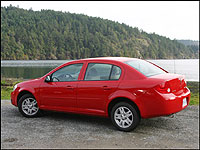 |
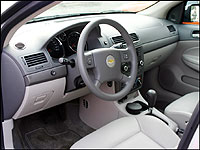
| The Pursuit and Cobalt are both a step up from most competitors in this class when it comes to interior quality, and light years ahead of their predecessors. (Photo: Trevor Hofmann, Canadian Auto Press) |
basic architecture, engineering and the majority of its sheetmetal, there are a few extras in the Pursuits corner that give it a distinctive character when compared side by side with its bowtie cousin.
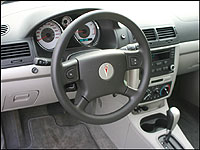
For starters there are unique white-face sport gauges in the instrument cluster, a nice complement to the racy red exterior paint finish of my loaner. The interior is also highlighted by brushed nickel-colored accents, a step up from the standard black plastic of the Cobalt. Actually, the Pursuit and Cobalt are both a step up from most competitors in this class when it comes to interior quality, and light years ahead of their predecessors. Everything fits together well, is ergonomically correct and attractive to look at.
Truly, the Cobalt and Pursuit have been executed to such a high standard that it's quite clear there's more at stake here than
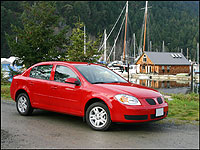 |
| With the Pursuit and Cobalt, GM is now showing it can build a small car as good, and in some ways better than its Japanese rivals. (Photo: Trevor Hofmann, Canadian Auto Press) |
keeping current compact GM buyers happy and attracting new buyers to the two respective brands, these two cars are about pride. There have been too many Cavalier and Sunfire jabs over the years, and GM is now showing it can build a small car as good, and in some ways better than its Japanese rivals.
"This isn't just another small car entry," said Doug Parks, GM Canada's Vehicle Chief Engineer. "This is our big swing at the plate with regards to a small car"
With regards to the Pursuit, the most obvious standard Pursuit feature, which wasn't included in my tester due to its
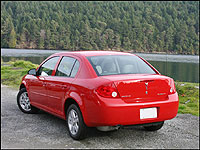 |
| The only performance enhancing feature the Pursuit SE gets over the base model are standard ABS brakes, larger 16-inch alloy wheels and 205/55R16 all-season tires. (Photo: Trevor Hofmann, Canadian Auto Press) |
preproduction status, is a rear decklid lip spoiler. Ironically I had a chance to see it fixed to a top-tier Cobalt LT I was testing earlier that day, and really feel it finishes the car off.
The Pursuit is available in two trim levels by the way, the base sedan just mentioned and a sportier SE model. The differences between the two mostly come down to features and trim upgrades, including the addition of air conditioning (standard on the base Cobalt), antilock brakes, power windows, locks and mirrors, cruise control, fog lamps, a 3.5-inch chrome tipped exhaust pipe, and a nicer audio head unit. Other than the ABS brakes, the only performance enhancing feature the SE gets are larger 16-inch alloy wheels and 205/55R16 all-season tires, which do help out when pushing the apex of a corner.
And it really does handle well, in either base or SE configurations. I was actually surprised at how easily it negotiates
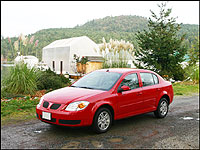 |
| I was actually surprised at how well the Pursuit negotiated tight, undulating bends, no matter how corrupt the pavement beneath the tires. (Photo: Trevor Hofmann, Canadian Auto Press) |
tight, undulating bends, no matter how corrupt the pavement beneath the tires. I really shouldn't have been so shocked, being that the Pursuit rides on the same Delta chassis architecture that makes the ION Coupe Red Line so wonderfully engaging out on the open road. The Pursuit is not quite as "tossable" as the Red Line, which makes sense being that it's not a sport-tuned compact per say, but it is up near the top of its entry-level class while also offering a better than average ride.
It's true, the Pursuit rides like a much larger car than it is. The fully-independent suspension setup has much to do with
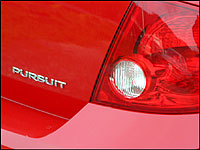 |
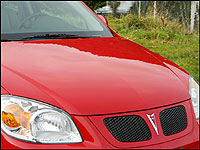
| Thanks to a more rigid frame, Pontiac was able to greatly improve panel gaps and fit and finish over the Pursuit's predecessor. (Photo: Trevor Hofmann, Canadian Auto Press) |
this, with added hydraulics/damping to the Boga suspension bushings, the rear bushings copied from one of its rivals according to Parks, absorbing impacts and enhancing quietness. Also, premium-level monotube shocks just like those used in the Corvette, another first for the small car segment.
As mentioned previously the Pursuit is much more rigid than its predecessor, allowing Pontiac to close up exterior panel gaps and improve interior fit and finish, which makes it look much more refined, and also optimize handling while still maintaining a supple ride.
"Twenty-eight hertz is about as good as it gets," stated Parks, "which allows the suspension to do what it's supposed to, which is absorb the irregularities of the road."
The steering rack is also optimized for quiet operation and improved feel, while no compromise tires make a big difference
 |
| Pontiac chose to bias the Pursuit towards ride and handling quality over fuel economy. (Photo: Trevor Hofmann, Canadian Auto Press) |
in the car's overall balance, ride and handling. Actually, Pontiac chose to bias the Pursuit towards ride and handling quality over
fuel economy, giving up two tenths at the gas pump in order to give the car improved driving dynamics. According to Parks each tire and wheel has been given its own calibration, tuned to optimize the car's overall feel while out on the road.
Not only does the Pursuit raise its game with regards to ride and handling, but I think a great deal of credit needs to go to GM's engineers who additionally managed to isolate all the grumbles and groans that normally seep out a cars' chassis, engine bay and other components into the cabin. Rather, the Pursuit an especially quiet car.
In achieving this a variety of steps were taken, including the addition of a
 |
| Pontiac engineers put in plenty of hours to ensure the Pursuit is an especially quiet car. (Photo: Trevor Hofmann, Canadian Auto Press) |
special polymer coating on pistons, which reduces friction and therefore noise, plus attachments between engine and transmission, adding strength to stiffen the powertrain which drops bending noise. Also, the inclusion of a structural oil pan makes the engine area more rigid, which reduces noise, and cam chain and tensioner improvements also did their part to bring the decibel level down. Sound deadening includes the use of Quiet Steel in the plenum and front of dash. Quiet Steel is basically two layers of laminated sheetmetal stuck together with Visco elastic material. Parks made a point of saying, "No one has Quiet Steel in this segment!"
While additional sound deadening material has been added to the front and rear floorpan, enhancing the high quality
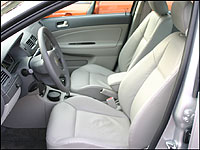 |
| From the ground up, the Pursuit is built to a much higher standard than most in its field. (Photo: Trevor Hofmann, Canadian Auto Press) |
experience is foam-in-place carpet, the foam being injected along bottom of carpet prior to it being installed. The foam in place process is also used along the backside of each dash mat. On the other side of the firewall, GM "wall-papered" the engine compartment and then added a plastic molded engine cover to absorb additional chatter.
With regards to sealing out exterior noise, GM engineers once again went to extremes. "We were maniacal about closing and sealing out every gap in the car," added Parks.
So it makes sense that the new Pursuit would feel larger than a compact car.
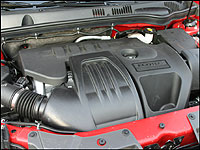 |
| The Pursuit's 2.2-liter Ecotec four-cylinder engine makes 145-hp, putting it near the top of the compact segment's base engine class. (Photo: Trevor Hofmann, Canadian Auto Press) |
From the ground up it's built to a much higher standard than most in its field.
Part of this sensation comes from its impressive power off the line. While I mentioned the improvements made to the engine as far as noise, vibration and harshness levels are concerned, performance is also up slightly from the 2.2-liter Ecotec four-cylinder used in the previous Sunfire, truly the best attribute the car had. Instead of an already peppy 140 horsepower, the Pursuit makes 145, putting it near the top of the compact segment's base engine class. It's still a 16-valve, dual overhead cam configuration, revving easily at the touch of the throttle and staying afire right to a breathy 6,800 rpm.
Despite the car's zippy performance it's extremely efficient, sucking back an average of 9.5 L/100 km in the
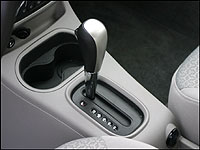 |
| Although it is fun to drive, the Pursuit is also extremely fuel efficient. (Photo: Trevor Hofmann, Canadian Auto Press) |
city and 6.1 on the highway.
I should also mention that the 4-speed automatic transmission I tested shifted through its gears quite smoothly, without the notchy interval sensation often experienced in the compact class. This is partially due to the engine's robust 155 lb-ft of maximum torque, available at a tractable 4,000 rpm. I tried out the 5-speed manual in the Cobalt, and found it especially well sorted. I have to admit to preferring it over the autobox, being that with a simple downshift the Pursuit transforms from comfortable cruiser to pocket racer.
That's when the larger diameter front disc brakes come in handy, bringing the 1,268 kilo (2,789 pound) Pursuit
 |
| When it comes to safety, GM has designed the Pursuit, like the Cobalt, to meet standards at the top of the class. (Photo: Trevor Hofmann, Canadian Auto Press) |
from highway speeds to a crawl in short order. Drums are in the rear, which is more or less standard fare in the compact class, and ABS is optional. No doubt four-wheel discs will become available in sportier versions of the Pursuit, as such have already been announced in the Cobalt SS. I pushed the little Pursuit quite hard through a few stretches of curving, undulating highway, mind you, and never felt a need for any more braking power than was served up.
As far as safety issues go, rest assured GM has designed the Pursuit, like the Cobalt, to meet standards at the top of the class. Internal tests give it a 5-star rating, and there's no reason to believe that when the government does its smash 'em up routine the car will fare any worse.
What does a new Pursuit cost? The starting price is $15,925, which is quite
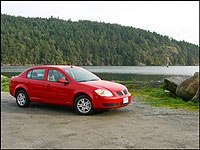 |
| While the Pursuit may not be "the best" in the compact class, it can hold its own against the imports. (Photo: Trevor Hofmann, Canadian Auto Press) |
competitive when compared to the top-selling Honda Civic at $16,200, second place Corolla at $15,490 and popular Mazda3 at $16,295. Dynamically it's more exciting to drive than a Civic, more refined than a Corolla and offers more diversity with regards to features and trim variety than the Mazda3. While I wouldn't go so far to say it's the best in the compact class, it now can hold its own without the caveat, "Pretty good for a domestic."
Now Pontiac sells a "no excuses small car", something the brand hasn't been able to boast about for decades. Too bad the American division can't say the same.
Specifications:
- Price Range (base MSRP): $15,925
- Body Type: 4-door sedan
- Layout: front engine, FWD
- Engine: 145 hp, 155 lb-ft of torque, 2.2-L, 16-valve DOHC I-4
- Transmission: 5-spd manual (optional 4-spd auto)
- Brakes (front/rear): disc/drum (optional ABS)
- Curb Weight (estimated): 1,268 kg (2,789 lbs)
- Seating Capacity: 5
- Cargo Volume (trunk): 394 L (13.9 cu ft)
- Fuel Economy (city/hwy): 9.5 / 6.1 L/100 km
- Warranty (mo/km): 36/60,000 comprehensive - 60/100,000 powertrain
- Direct Competitors: Chevrolet Cobalt, Dodge SX2.0, Ford Focus, Honda Civic, Hyundai Elantra, Mazda3, Mitsubishi Lancer, Nissan Sentra, Subaru Impreza, Toyota Corolla, VW Golf / Jetta
- Web Site: www.gmcanada.com
Note: Additional larger photos are available in the photo album.
 Imprimer