The rich tradition of Saab products is well established and recognized worldwide. The Swedish company has given us a series of distinctive, dynamic cars over the years and generations. However, since General Motors acquired Svenska Aeroplan Aktiebolaget in the 1990s, the lineup went through a normalization process and lost a great deal of passion.
For 2008, Saab goes back to its roots by offering something much more inspiring. The new
all-wheel drive Turbo X is arguably a "blast from the past".
Based on the conventional 9-3 sedan and wagon, this machine truly lives up to the Trollhöttan brand's reputation. Engineers and designers were given a lot more freedom this time around. Beyond the ultra-aggressive body lines, the design of the Turbo X is almost all-new. Yet, it proves to be unmistakably Saab -- perhaps even more than regular models.
Available in black only, the car retained one of the automaker's famous design cues: the 3-spoke wheels. Well, actually, there are three twin spokes, with a titanium finish, but the family ties are still striking and, just like the rest of the Turbo X, these alloys mark an evolution with their 18-inch diameter.
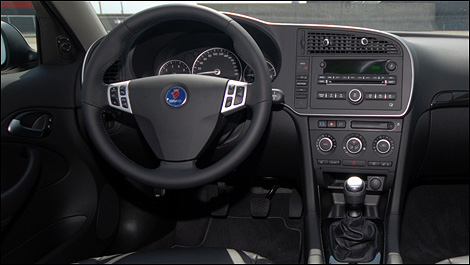
The cockpit-style interior is equally evolving, though the control panel is simple and easy to use. Aside from the navigation system, the equipment level is only decent and the ventilating system is a bit noisy. Material selection as well as fit and finish are quite good, with subtle carbon fiber accents adding a touch of class.
The quality seats help you relax, though the relative lack of legroom requires you to slide the seat back to enjoy a comfortable yet sporty driving position. Headroom is abundant and the tilt/telescopic steering wheel allows you to feel more at ease with the car. Cargo capacity is modest, but when you fold the 60/40 split rear seatbacks, it becomes much more accommodating.
Elsewhere, the Saab 9-3 Turbo X benefits from technical and dynamics upgrades. Developed with Haldex from Stockholm, Saab's AWD system is actually called "Cross Wheel Drive" and it's mated to an all-aluminum engine producing 280 horsepower and 295 pounds-feet of torque -- the highest output ever achieved by a Saab. I'll tell you, this XWD technology is unbelievably effective and virtually seamless.
The chassis is so technically sound that the car could easily use a couple more ponies. The twin-scroll turbocharger is not brutal at all; on the contrary, it proves flexible and reasonably fuel-efficient (11 L/100 km).
The 10-mm lower suspension is firm during emergency braking maneuvers yet surprisingly compliant on bumpy roads. Meanwhile, the upgraded brakes get larger ventilated discs (345 mm up front and 292 mm in the back) for controlled and, most importantly, fade-free stops.
The steering is nicely assisted and precise. On the other hand, the transmission lacks some purpose; it should be firmer and deliver quicker shifts so as to improve the sporty feel. As for handling, considering the XWD system of the Turbo X, I was expecting a more solid performance. Due to the overhanging engine, the front end of the car seemed less lively upon entering corners, especially sharp ones, which resulted in significant understeer.
Admittedly though, without being a world-class athlete, this sedan can tackle just about any road condition. Grip changes are dealt with in impressive fashion. The XWD system, high stability and gobs of torque make this 9-3 very safe and capable on the road. That, in a nutshell, is the real strength of the Turbo X.
ConclusionAfter spending a few years in the shadows, Saab is once again under full spotlight thanks to the
2008 9-3 Turbo X. As competent as one could wish, it sports a number of design cues that have elevated the brand to the ranks of nearly mythical cars. Performance is on the menu for sure, even though the car doesn't seem perfectly balanced.
Having said all that, the biggest drawback of the Saab Turbo X is the $54,995 MSRP (or $56,305 for the SportCombi wagon variant). That's simply too much money, especially when compared to segment leaders.
 Print
Print