I obtained my car racing licence at the last event held at the short St. Eugene track, near Rigaud on the Quebec-Ontario border, in May 1964, three months before the short Mt-Tremblant course opened in August of the same year. From then to today, I must have driven (Ridden) car or bikes on 25 tracks across America, England, France and South Africa.
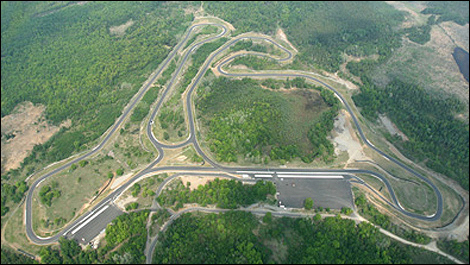 |
| Several track configurations increase the usability of the site. We ran the full course, taking full advantage of this great layout. No doubt about it, this place is a world class track facility, located in beautiful countryside. |
So when I got to Calabogie (Just North of Ottawa) for my first ARC-Turn2 Sportbike School day in September 2009, I did not expect to have to work too hard to learn the track – jeez, it’s just another a strip of pavement! How wrong I was, as four 20-min sessions and 35 odd laps later, I knew roughly which way the track went but was nowhere close to figuring out the line or having established any useful braking reference points.
Calabogie – More than meets the eye
The three-hour ride home afforded me some time to debrief myself, and I was still stumped for another several hours. Then the tricks used by track designer Alan Wilson to complicate quick riding there came to me.
Firstly, Calabogie corners come in pairs or even threesomes, combined in a way that forces you to always position yourself for the most important corner, usually but not always the last one in the string. Wilson made sure the lines were complicated by varying corner speeds and direction, to always lure the unwary onto a seemingly better but ultimately slower line. Learning proper lines through four or five clusters of corners over the 5.5km track will take time, I assure you.
The second trick our boy Wilson resorted to was to use the natural up-and-down lay of the land to create corners that drop off and disappear at the end of most straightaways, a little like “Links” golf courses. This means that you cannot see the actual braking or turn-in points when approaching most corners at high speed – you only see the braking point at the last moment before having to apply the brakes hard! It also means that wusses like me chicken out and brake early. Funny how as racers, we have taught ourselves to turn into a corner without having spotted the apex (Think corners 2, 3 and 4 at Mosport, or 7 and Namerow at Tremblant), but holding the throttle wide open past a certain point and braking blind is much more difficult, at least for me.
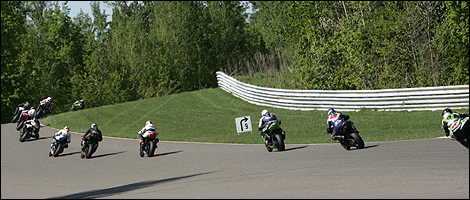 |
| And off we go into the wood... These undulations are a great source of complexity when learning the track, and of satisfaction when we finally get the lines right. |
Learning the track
The early morning presentation by lead instructor John Bickle was more impressive than instructive for me, as he sure knows the track layout and the quick lines around the track, and I could see the depth of knowledge there. I knew the riding theory but the pictures of the various corners left more confused than informed.
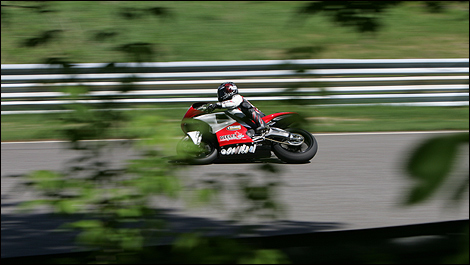 |
| Green is everywhere at Calabogie, giving it a natural feeling that one cannot get at other pllaces closer to large urban centers. |
The actual riding was great fun! I first went out on the track in early afternoon, on a Kawasaki Ninja 250R, my first ride in anger on that bike. The bike’s performance was just what I needed for a first seven- or eight-lap stint, whereupon I retired to the pits still unable to tell you which way the track went.
A good, long look at the course map was followed by an exciting session on a Kawasaki 650R, a wonderful bike but more than I could manage while still learning my way round the place. My last two sessions saw me back on the 250R, giving me enough time to look around for my marks, and remember where I had gone the lap before and how to correct it.
What did I (re)learn in one day with Turn” at Calabogie?
This is my moment of truth:
- You can always learn – even at my advanced age and generous experience level...
- The Calabogie track features layers of complexity that need to be learned gradually. At a Turn” Track Day, a raw novice can start by learning how to operate a bike, then move up his pace and learn about trajectories, then step up braking and cornering pace, then start to approach his/her limits as reference points are set.The track layout grows in complexity to match the increasing skills of a rider – always accompanied by experienced and ever so patient Turn2 coaches.
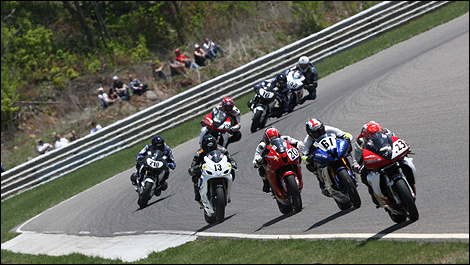 |
| Not a lot of spectator installations these days. You go out there to be one with your bike and the track - no intrusions please! |
- The approach used by the Turn2 School optimizes fun, learning and thrills. There was none of this confusing “You brake here, then turn in here, etc…” in the morning session, but rather a review of the track layout to minimize surprises. Students are encouraged to ride the track in order to help them develop their skills as the day goes on, with judiciously placed pylons for those who noticed and can make use of them. There was never any pressure, just a constant gentle encouragement by the coaches to help the riders develop their skills safely.
- The Kawasaki Ninja 250R and 650R are great learning tools and a lot of fun. Both bikes are safe and non-threatening on the street, but the 250 is especially effective as a safe learning tool. The lack of immediate power on the 250R means less effort needed to keep it on the island, and more extra attention available to see where you are, where you should be, and enough time to remember and correct yourself on the next lap. Stay on the 250 until you are turning stready lap times and feel that you can stay on the correct line lap after lap. Then go to the 650R.
- And finally, if you are a novice rider or racer, or even an amateur racer, forget about learning anything aboard a 600 or 1000 Sportbike, as they are too quick and hard to ride on track at any pace for a novice.The Turn2 Superbike School can lend you a Kawasaki ZX-6R if you want to see what they are like, while the instructors and Pro riders, who live in another world in terms of track knowledge and lap times, get to ride ZX-10R crotch rockets – way too quick for me!
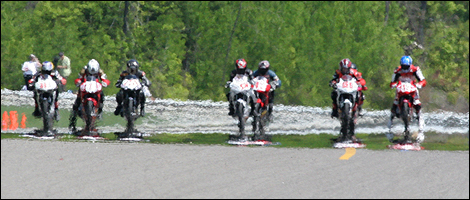 |
| The track is wide and safe, as these CBR125R riders can see. |
Start slow – then build up skills and safe speed
My recommendation is to leave your ego at the gate and get on a 250R, at least for the first two days on track. And when you think that you have mastered the little bike, ask Jonh(s) Bickle or Sharrard about good 250R lap times, then get back at it!
The Turn2 organisation can accommodate everyone from a raw novice to an experienced racer, with the bikes, riding coaches and knowledge to take you to the next step.
The price one pays for an error aboard a bike on a track or the street is too great to take the sport lightly. Learning how to do it properly is paramount for safety (Yours and that of the other riders) as well as enjoyment. In fact, getting better at it increases enjoyment and safety exponentially.
The Turn2 – Ninja 250R – Calabogie triumvirate have this thing sussed out – crazy for us not to take advantage of it!
Thanks to George, John(s) Bickle and Sharrard, Natalie Provost and Éric Moffette for you help, knowledge and patience.
 Print
Print