You don’t perform a road test with a delivery truck like you would with any other vehicle. Obviously, for a lot of people, starting with my lovely wife, driving the all-new 2010
Ford Transit Connect for a full week seemed pointless. After all, I have absolutely no intention of becoming a delivery guy, and testing commercial vehicles is not exactly my job.
 |
| Whether as a cargo van or a touring wagon, the 2010 Ford Transit Connect offers good value in the commercial vehicle market. |
Admit it, though, the Transit Connect is pretty unique. Created by Ford of Europe, this self-defining styling exercise has produced not only a new alternative for small businesses and delivery companies, but also a touring variant, mainly targeting families.
That didn’t stop some of my friends from making fun of me, however. Even my own son wondered why the milkman kept parking his truck in our driveway!
Based on the Focus
The highly-accommodating and decidedly-utilitarian Transit Connect rides on the same platform as the
Focus. Built in Turkey, this new Ford product is putting a clear emphasis on versatility to make a lasting impression over here.
From a mechanical standpoint, the Transit Connect benefits from a 136-horsepower, 2.0-litre I-4 Duratec, a familiar and well-proven engine from the blue-oval automaker.
The 4-speed automatic transmission it’s mated to is not sophisticated by any means yet fulfills its duties effectively. In some situations, an additional gear (or two) would be much appreciated to help in rev matching.
Nicely thought out
But the point of creating a vehicle like the Ford Transit Connect is to offer outstanding functionality in a clever layout. Earlier this year, at the
Chicago Auto Show, the company unveiled various interior configurations, from flower and pastry delivery to jazz mobile. Missing at the time was the five-passenger wagon variant with rear seats and rear side glass.
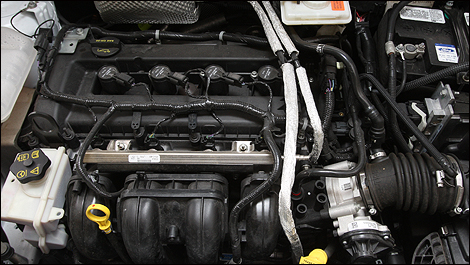 |
| From a mechanical standpoint, the Transit Connect benefits from a 136-horsepower, 2.0-litre I-4 Duratec. |
In case you haven’t figured it out yet, the Transit Connect is initially a two-passenger vehicle with a cavernous cargo box and windowless side panels in the back. The utility area is well thought out with a fully-rubberized floor and a flat structure that can receive an entire set-up. Of course, with an overall height of about 2 metres, you won’t be able to stand up inside.
 |
| The maximum cargo capacity amounts to 3,830 litres. |
I’d like to point out a few other convenient features. A button allows the rear doors to swing 180 degrees, while the sliding side doors uncover a large opening. All this makes access to the cargo area much easier, no contortions required. By the way, maximum cargo capacity amounts to 3,830 litres.
The boxy shape of the cargo hold is perfect to accommodate tall objects and install shelves. Yet, at the same time, the Transit Connect manages a fairly compact size. At 4.5 metres long, it occupies no more space than your average midsize sedan. Plus, the turning radius is about the same.
Worry-free
Surprisingly, the Ford Transit Connect does not exactly handle like a pickup truck. In my long career, I’ve had the opportunity to drive traditional vans like the Econoline and even cube trucks. Let me tell you that this Ford has nothing in common with those vehicles, at least on the road.
The steering is pleasant, and while accelerations are a bit sluggish when loaded, the Transit Connect has never been designed with pure performance in mind.
Also, the high driving position and expansive front glass provide impeccable forward visibility. When backing up, however, even the big outside mirrors fail to compensate for the lack of visibility. Fortunately, as I said earlier, the turning radius is short and makes parking manœuvres less challenging.
 |
| A button allows the rear doors to swing 180 degrees, while the sliding side doors uncover a large opening. |
Great news: the Transit Connect proves to be quite fuel-efficient, too. Throughout my road test, I maintained an average of 8.8 litres per 100 kilometres. Granted, most of the time, the only package inside was me.
 |
| This self-defining styling exercise has produced not only a new alternative for small businesses but also a touring variant, mainly targeting families. |
Wrap-up
Whether as a cargo van or a touring wagon, the 2010 Ford Transit Connect offers good value in the commercial vehicle market. It receives a solid score overall, although pricing is a bit tough to swallow ($30,000 as tested, including freight and delivery charges)… not to mention that my son kept shouting: "Mom, the milkman’s here!"
 Print
Print